Loading...
Building a High-Intent Lead Generation System for a Driving School:
From Zero to 250+ Leads in 4 Months.
When a driving school starts with no online presence, the biggest challenge is not just visibility — it is attracting the right kind of users who are ready to book lessons. No website, no rankings, no traffic, no ad spend. The strategy was built entirely around user intent — and 4 months later the same site had delivered 100+ form submissions and 150+ direct phone calls.

Search Console Growth and Real Lead Submissions
Not projections. Screenshots straight from Google Search Console and the website's form-entry log — captured during the 4-month ramp.
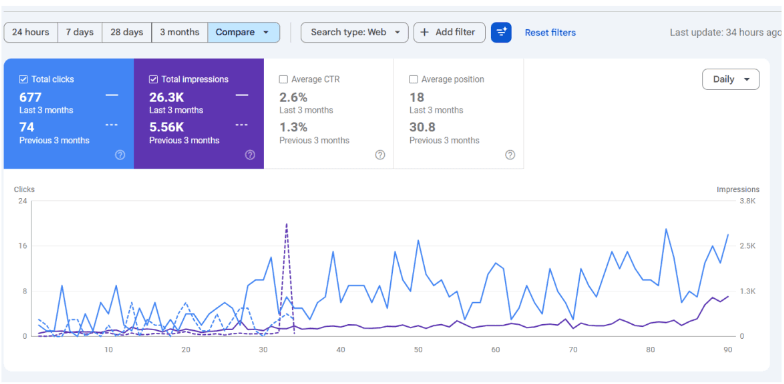
Search Console — 677 clicks (vs 74 previous), 26.3K impressions (vs 5.56K), CTR 2.6% (vs 1.3%), avg position 18 (vs 30.8)
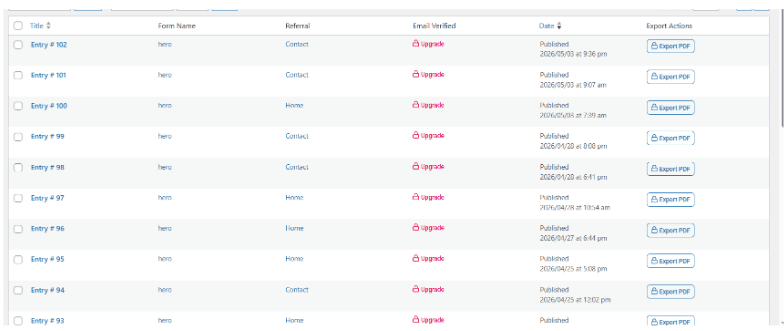
Form-entry log — 100+ inbound lead submissions, all from organic local search
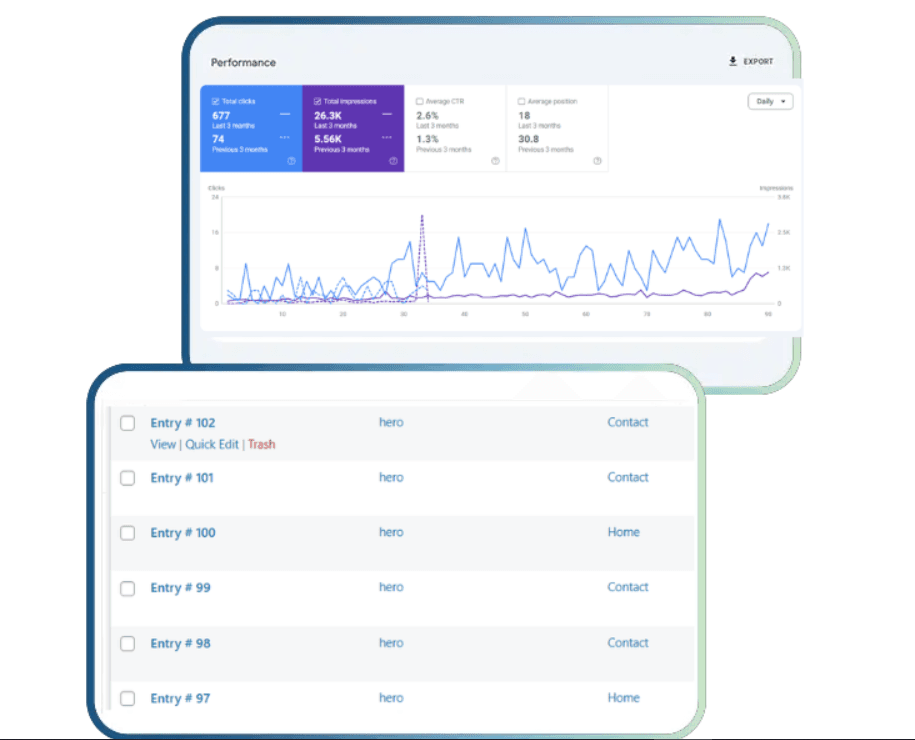
Search Console growth and lead submissions — the same compounding curve, viewed from both sides
A Completely Blank Slate. No Website. No Rankings. No Traffic.
This project began with nothing. No domain authority. No existing pages. No backlinks. No Google Business Profile traction. The objective was clear: generate consistent, qualified leads using local SEO — without relying on paid ads.
Instead of focusing on vanity metrics like traffic volume, the entire strategy was built around user intent — understanding what potential learners are actually searching for when they are ready to take action.
No website to start with
The site had to be designed and built from scratch with an SEO-first architecture, not retrofitted onto an existing build.
No rankings, no backlinks
Zero domain authority meant rankings had to be earned through tight on-page relevance and local signals — not muscle from history.
No budget for ads
Every lead had to come through organic search. There was no PPC safety net while SEO ramped up.
Highly competitive local market
Driving school keywords are dominated by established players with years of reviews and content — direct competition for broad terms was a losing fight.
Search Behavior in This Industry Is Highly Intent-Driven.
In the driving school space, users are not just browsing. They are looking for specific services such as automatic or manual lessons in their nearby area. Targeting broad terms like "driving school" is a vanity play — it brings traffic that does not convert.
Rather than chase volume, we focused on high-conversion queries that signal a user is ready to book:
→
automatic driving lessons in [city]
The user has already chosen a transmission type and a location — this is a near-bottom-of-funnel query.
→
manual driving lessons near [location]
Manual learners are typically more committed and more selective — the keyword filters in the right kind of student.
→
driving lessons in [defined service area]
Hyper-local intent. These users want a school close enough to drive to them or meet at a familiar pickup point.
This filter aligned the website structure directly with what users were actively searching for — every page tied to a clear, transactional query.
A Scalable SEO Architecture, Designed Page-by-Page Around Search Behavior.
Every page on the site had a single, defined purpose — and every URL pattern matched a specific kind of query. This is what kept the structure relevant, fast to rank, and easy to scale.
Service-Based Pages
Match the core transmission-type intent
/automatic-driving-[city]/manual-driving-[city]Each page targets the user's primary decision: do they want automatic or manual lessons, and where.
Location-Based Pages
Capture local demand by area
/driving-lessons/[city-A]/driving-lessons/[city-B]For users searching purely by location — the page surfaces all available lesson options for that specific area.
Combined Service + Location Pages
The deepest, highest-converting intent
/driving-lessons/[city]/manual/driving-lessons/[city]/automaticThese pages won the most qualified traffic. A user landing on "manual driving lessons in [city]" has already decided what they want — the page only needs to convert.
Every page had a clear purpose and matched a specific search intent. That alignment is what drove both the rankings and the conversion rate — there were no generic landing pages diluting the architecture.
Don't Spread Thin. Win Tight, Then Expand.
Trying to rank for an entire region from day one is how new sites stall. The campaign instead focused on proximity and relevance — winning a small radius first, then scaling out only after the local signals were strong.
01
Phase 1 — 5-mile radius
Targeting started inside a tight 5-mile radius. Concentrated content, focused service-area pages and aligned GBP signals built strong local authority quickly — and the first rankings came in faster than they would have for a wider net.
02
Phase 2 — 10-mile radius
Once Phase 1 stabilized, targeting expanded to a 10-mile radius. New service-area pages were rolled out for the additional locations, internally linked back to the existing authority — visibility scaled without diluting ranking power.
Step-by-step expansion is what kept growth sustainable.
Most local sites fail because they target too wide, too early — relevance gets watered down and nothing ranks. By compounding authority in a tight radius first, every subsequent expansion built on top of existing ranking power instead of competing with it.
Within 4 Months: 100+ Forms, 150+ Calls, Zero Ad Spend.
The results exceeded expectations — and more importantly, the leads were qualified. These were not visitors. They were users with clear intent to book driving lessons. The consistency of inbound enquiries proved the strategy was aligned with real demand.
100+
Form submissions
All from organic local search
150+
Direct phone calls
High-intent, ready-to-book
£0
Advertising cost
100% organic local SEO
250+ inbound leads in 4 months — from a website that did not exist at the start.
The site went from 0 to a reliable lead engine without a single pound spent on advertising. Every lead came from search, every search came from a clearly defined intent, and every page on the site was built specifically to capture and convert that intent.
Local SEO Success Is Driven by Intent Alignment — Not Keyword Volume.
The biggest lesson from this project: a brand-new website can become a reliable lead generation system in months — not years — when every decision is built around how users actually search.
✓
Structure the site around how users actually search
Service-based, location-based, and combined service+location pages each match a different real-world query. Generic landing pages waste authority.
✓
Target high-intent queries, not high-volume ones
"Manual driving lessons in [city]" converts. "Driving school" brings tire-kickers. Pick conversion over traffic every time.
✓
Scale geographically in controlled phases
Win a tight radius first, then expand. Local authority compounds — diluting it across too wide an area is what kills new sites.
✓
Visibility is not the only metric that matters
If a site is not generating consistent enquiries, the issue is rarely traffic. It is almost always intent alignment.
For driving schools and similar local service businesses, the opportunity is not in chasing more traffic.
It is in understanding user behavior and building systems that respond directly to it. If your current website is not generating consistent inquiries, the issue is rarely visibility alone — it is how well your strategy aligns with intent.
Want a Website That Actually Generates Leads?
Local SEO Services
How Rankixa builds intent-driven local SEO systems for service businesses.
Learn moreGoogle Business Profile Case Study
0 to 133 calls in 6 months for the same kind of driving school — pure GBP optimization.
Learn moreScaled Google Ads Case Study
£525 spend, 68 conversions, £7.72 per conversion — the paid companion to organic SEO.
Learn moreGet a Free Local SEO Strategy Call
We will map out the search intent in your area, identify the highest-converting queries, and show you exactly what an intent-driven structure would look like for your business.
Book Free Strategy Call