Contents
- What Does SEO Mean for Driving Instructors?
- Benefits of SEO for Driving Schools
- How to Get Started: 19 Steps
- 1. Audit and Keyword Research
- 2. Google Business Profile and Map Pack
- 3. Website Pages Learners Book From
- 4. Turn Visitors into Booked Lessons
- 5. Technical Basics
- 6. Local Links and Authority
- 7. Tracking and Ongoing Strategy
- Mistakes to Avoid
- 90-Day SEO Plan
- Timelines, Directories & Agencies
- Other Marketing Methods
- Rankixa Services & Pricing
- 1Your Driving School4.9 (128) · Driving schoolAutomatic & manual · Open now
- 2Town Centre Driving4.6 (54) · Driving schoolManual lessons · Closes 6 pm
- 3Northside Instructors4.4 (31) · Driving schoolIntensive courses · Closes 5 pm
SEO for driving schools means making sure learners in your area find you on Google at the exact moment they decide to start lessons.
When someone decides it is time to start driving lessons, they usually have a few immediate questions like:
- Which driving schools teach near me?
- Do they offer automatic or manual lessons?
- Are the instructors patient and reliable?
- How much do lessons cost, and how soon can I start?
Learners, and the parents who often pay for lessons, take those questions straight to Google. If your school is not in the results when they search, they book the instructor who is.
You do not need to be an SEO expert to change that. This guide is written for UK driving schools and independent Approved Driving Instructors (ADIs). It covers 19 practical steps in the order that brings in pupils fastest, with examples from real Rankixa driving school campaigns.
In a 2025 BrightLocal local-search survey, 45% of consumers use Google as their default way to find a local business, while another 15% start their search directly in Google Maps. Reviews matter too: 67% of consumers often or always read reviews after a local search.
What Does SEO Mean for Driving Instructors?
SEO for driving instructors is the process of optimising an instructor’s website, Google Business Profile, and online listings so that learners searching for driving lessons in a specific area find that instructor first. Search engines match a learner’s query, such as “automatic driving lessons in Morden”, to the instructor whose pages, profile, and reviews answer it best.
In practice, an instructor’s SEO covers three connected things. Local SEO puts the business in the Google Maps results for the areas it teaches in. On-page SEO gives each lesson type and location its own page. Off-page SEO earns the reviews, citations, and links that tell Google the instructor is established and trusted.
Google decides which driving schools to show in local results using three factors:
- Relevance: how closely your profile and pages match the search.
- Distance: how near you are to the learner or the area they searched.
- Prominence: how well known and well reviewed your school is.
Every step in this guide improves at least one of the three.
Is SEO Necessary for Driving Instructor Websites?
Yes. SEO is necessary for any driving instructor who wants a steady flow of new pupils without relying only on referrals or paid adverts.
Learners and parents choose an instructor by searching Google, comparing the first few results, and reading reviews. A website that does not rank for lesson searches in its own area is invisible at the exact moment a learner is ready to book. Pupils also leave once they pass, so an instructor needs a constant supply of new enquiries. SEO provides that supply every month, whereas word of mouth rises and falls.
What Are the Main Benefits of Implementing SEO Strategies for Driving Instructors?
The key advantages of SEO for driving instructors are more local visibility, better-quality enquiries, and a lower cost per pupil over time. There are 6 main benefits.
- More enquiries from learners in your area: Ranking in Google Maps and local search puts you in front of learners in the postcodes you already cover, so less time is lost travelling between lessons.
- Pupils who are ready to book: Someone searching “driving lessons near me” or “intensive driving course” has already decided to learn. Search traffic converts better than interruption advertising.
- Lower cost per pupil: A ranking page keeps sending enquiries without a charge per click. The cost of winning each pupil falls as rankings mature.
- Trust before the first phone call: Reviews, pass photos, and clear instructor credentials answer a parent’s questions before they make contact, which shortens the decision.
- A full diary all year: Demand for lessons shifts with school terms, birthdays, and test waiting times. Consistent visibility smooths out the quiet weeks.
- An edge over larger schools: Because distance is a ranking factor, a well-optimised independent instructor can outrank a national brand in their own town.
Together these benefits turn a website from an online business card into the main source of new pupils.
How Can Driving Schools Effectively Get Started with SEO?
Start by finding out where you stand and what learners search for. Then fix your Google Business Profile, build the pages learners book from, make booking easy, tidy up the technical basics, earn local links, and track everything against booked lessons. The 19 steps below follow that order.
Part 1
Audit and Keyword Research
Steps 1 to 3 show where you stand today and which searches are worth winning, so you do not guess what to fix first.
1. Start with a Local SEO Audit
A local SEO audit is a health check of everything that affects how your driving school appears in local search. It shows what is working, what is holding you back, and where the quickest wins are.
Doing this first stops you spending weeks on changes that make no difference. Most driving schools find two or three problems, such as a half-empty profile or a missing lesson page, that are costing them most of their enquiries.
Check these eight areas:
- Google Business Profile: Name, phone, website, hours, service areas, and categories are complete and correct.
- Local relevance of your website: Every page makes clear where you teach, which lessons you offer, and how to book.
- Keywords: Your main pages use the words learners actually search for.
- Lesson and location pages: Each main lesson type and teaching area has its own page.
- Business listings: Your name, address, and phone number match on every directory.
- Reviews: How many you have, how recent they are, and whether you reply.
- Mobile experience and speed: Pages load quickly and are easy to use on a phone.
- Technical issues: Broken links, missing page titles, duplicate pages, and pages Google cannot index.
2. Find the Keywords Learners Actually Search For
Keywords are the words learners type into Google. Driving school searches combine a lesson type with a place, such as “automatic driving lessons Croydon” or “driving instructor near me”.
Each search also carries an intent, which tells you what the learner wants and which page should answer them. Learners searching to book want a lesson page with prices. Learners comparing schools want reviews. Learners still researching want a helpful guide.
Find keywords by typing your lesson types and towns into Google and noting the autocomplete suggestions and the “People also ask” questions. Search Console shows the searches you already appear for, and a keyword tool adds monthly search volumes. Then give each group of keywords one page.
| Example search | Intent | Page that should rank |
|---|---|---|
| driving lessons [town] | Book | Location page for that town |
| driving instructor near me | Find | Google Business Profile and homepage |
| automatic driving lessons [town] | Book | Automatic lessons page |
| intensive driving course [town] | Book | Intensive course page |
| Pass Plus course [town] | Book | Pass Plus page |
| driving lesson prices [town] | Compare | Prices page |
| best driving school [town] | Compare | Homepage with reviews and pass photos |
| how many driving lessons do I need | Learn | Guide or blog article |
| [test centre] test routes | Learn | Local test centre guide |
3. Define Your Target Students and Map Your Topics
Target students are the specific groups of learners you want to attract. A 17-year-old beginner, a nervous adult returning after years away, an international licence holder, and someone who needs to pass within a month all search differently and need different reassurance.
A topical map is the plan of every subject your website should cover. Build it in three layers. Lessons: manual, automatic, intensive, refresher, motorway, and Pass Plus. Test preparation: the theory test, hazard perception, show me tell me questions, and what happens on the practical test. Safety guides: night driving, bad weather, and motorway rules.
Each topic gets one page, and each page links to its related topics. Covering the subject fully is what allows a small local site to compete with large national ones.
Part 2
Google Business Profile and Map Pack
Steps 4 to 7 decide whether you appear in the Google Maps results, which is where most local lesson enquiries begin.
4. Claim, Verify, and Complete Your Google Business Profile
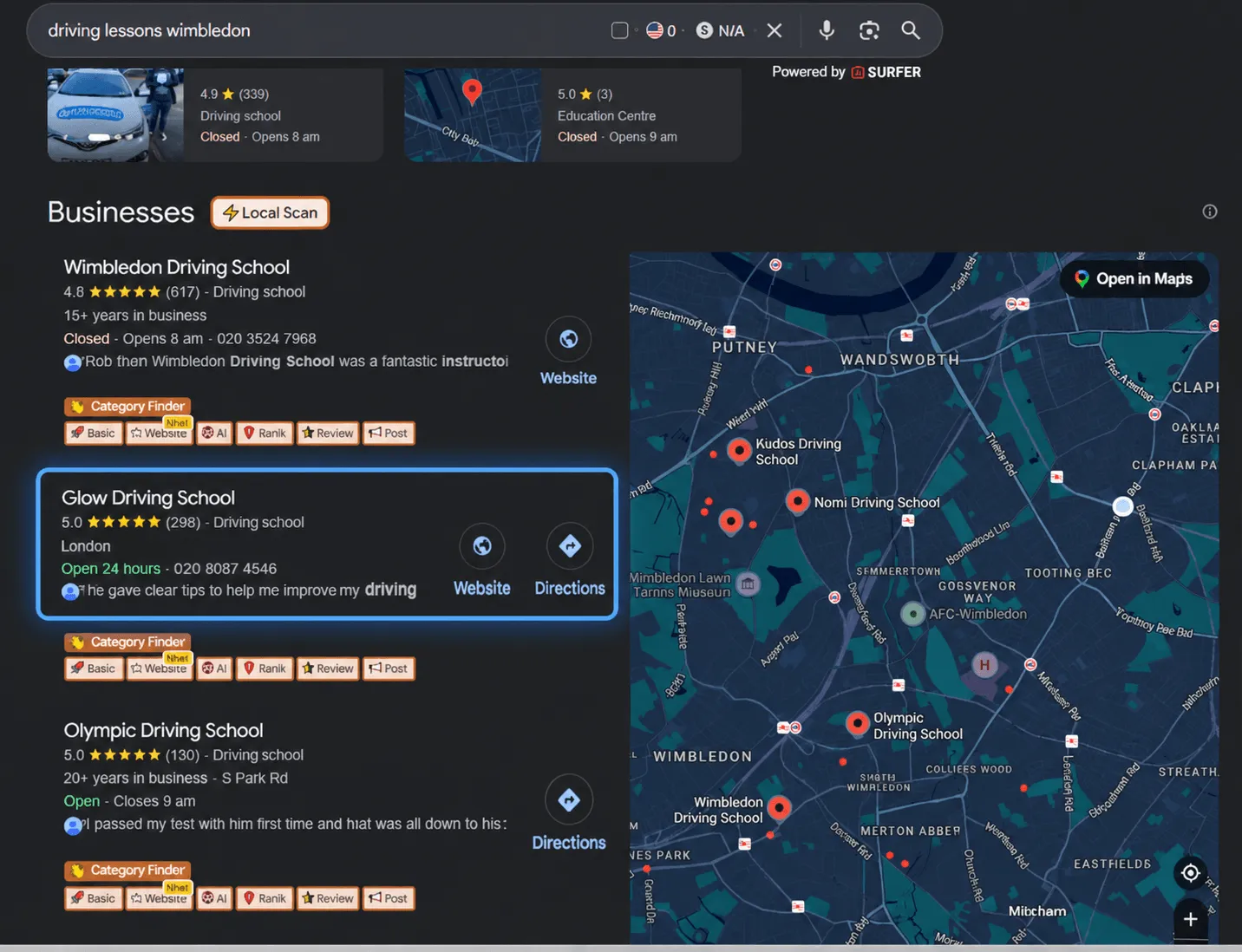
Your Google Business Profile is the free listing that shows your name, reviews, phone number, and hours in Google Maps and the local results. Bing Places and Apple Business Connect do the same for Bing and Apple Maps, so claim all three.
Set “Driving school” as your primary category, or “Driving instructor” if you teach alone, and add secondary categories only where they are true. List the specific towns or postcode districts you cover as service areas rather than a whole county, because Google favours areas close to your base.
Fill in every field:
- Business name: Your real trading name, with no extra keywords.
- Phone number and website: The same number and address you use everywhere else.
- Hours and service areas: When you take calls and where you teach.
- Description: Who you teach, which lessons you offer, and the areas you cover, written naturally.
- Services: Each lesson type: manual, automatic, intensive, refresher, motorway, and Pass Plus.
- Booking link: A direct link to your booking or enquiry page.
- Photos: Your instructors, tuition cars, and pupils who have passed (with permission).
5. Keep Your Name, Address, and Phone Number Consistent Everywhere
Name, address, and phone number are known together as NAP. A listing that shows them is called a citation. Search engines compare your citations across the web to confirm that the business is real and located where it says.
Conflicting details, such as an old mobile number on one site and a new one on another, weaken that confirmation and send learners to a dead line. Pick one exact format and use it everywhere: your website footer, Google, Bing, Apple, Yell, Facebook, and the GOV.UK driving instructor finder.
Audit existing listings with a citation tool such as BrightLocal or Whitespark, correct the mismatches, and remove duplicates. Consistent NAP steadies map rankings.
6. Build a Steady Review Habit and Reply to Every Review
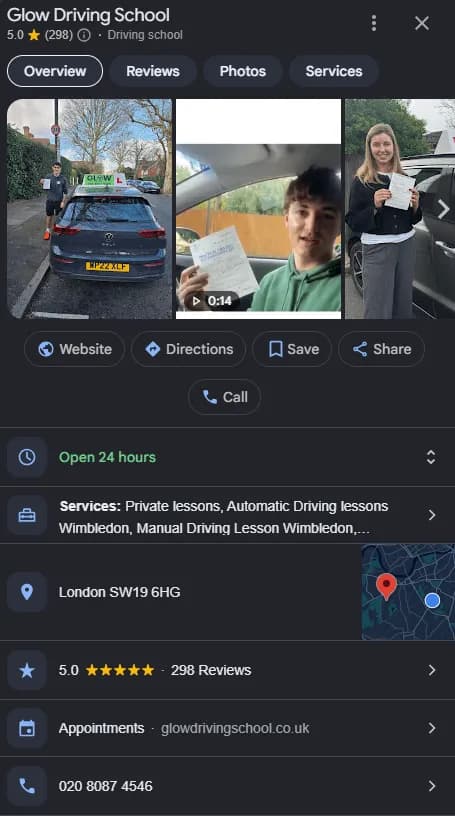
Reviews influence both where you rank in the map results and whether a learner chooses you over the school listed next to you.
The best moment to ask is the day a pupil passes. Send a direct review link by text or WhatsApp while they are still celebrating. Ask every pupil, not only the confident ones, so reviews arrive steadily rather than in bursts. Suggest they mention the lesson type and the area they learned in, which adds useful local detail.
Reply to every review within a day or two, thank the pupil by name, and answer criticism calmly and factually. A steady stream of recent reviews with replies lifts both rankings and enquiry rate.
7. Post Weekly Updates on Your Profile
Profile posts are short updates that appear on your listing. They show learners, and Google, that the business is active.
Post once a week: a new pass with the pupil’s permission, availability for intensive courses, a block-booking offer, or a short tip on roundabouts or parallel parking. Add a photo and a booking link to each post.
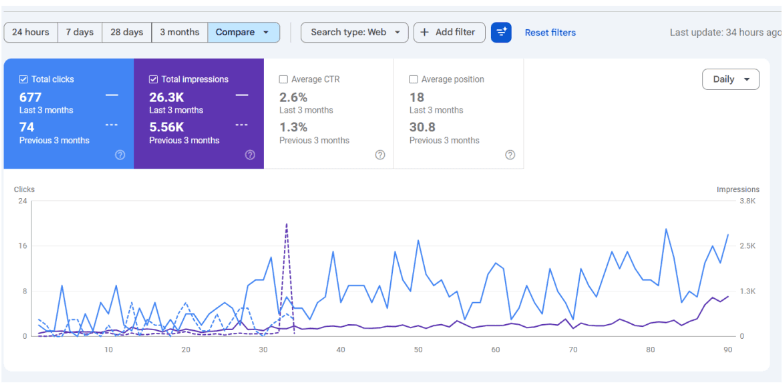
An active profile earns more clicks and calls than a static one. One driving school Rankixa worked with went from 0 to 133 calls in 6 months through profile work alone.

Part 3
Website Pages Learners Book From
Steps 8 to 11 cover the pages learners read before they decide to book, and how Google understands them.
8. Build a Page for Every Lesson Type You Offer
Google ranks pages, not websites. A single “Services” page listing everything cannot rank well for “automatic driving lessons” and “intensive driving course” at the same time.
Give each lesson type its own page. Explain who it is for, how long lessons last, what it costs, who teaches it, and how to book, then answer the questions learners ask about it.
Common lesson pages for a UK driving school:
- Manual driving lessons: The core page for most schools.
- Automatic driving lessons: A fast-growing search, especially from adult learners.
- Intensive and semi-intensive courses: For learners who need to pass quickly.
- Refresher lessons and nervous drivers: For adults returning after a break or lacking confidence.
- Motorway lessons and Pass Plus: For new drivers. Pass Plus can also lower insurance costs.
- Theory test and test preparation: Mock tests, hazard perception, and show me tell me questions.
9. Create Location Pages Without Copying Content
If you teach in more than one town or suburb, a page for each main area helps you appear for searches like “driving lessons Sutton”. Only create pages for areas you genuinely cover.
The most common mistake is copying one page and changing the town name. Google tends to index one version and ignore the rest, and learners can tell. Each page needs local detail that only a real instructor would know.
A strong location page includes:
- The area and nearby postcodes: Exactly where you teach.
- Lessons available there: Manual, automatic, intensive, or all three.
- Pick-up points: Home, school, college, workplace, or the station.
- The nearest test centre: Typical test routes and tricky junctions or roundabouts.
- Local reviews: Reviews or pass photos from pupils in that area.
- A clear call to action: A button to book or check availability.
10. Optimise Page Titles, Descriptions, and Internal Links
The page title is the headline shown in Google. Put the lesson type and location near the start, for example “Automatic Driving Lessons in Kingston”. The meta description underneath should give a reason to click: pass results, availability, or a first-lesson offer.
Internal links connect your pages. Link from your homepage to your main sections (lessons, areas, test preparation), from each section to its individual pages, and from each page back up and across to related pages. Use descriptive link text such as “automatic lessons in Kingston” rather than “click here”.
Describe every image plainly in its alt text, such as “pupil holding pass certificate outside Morden test centre”.
11. Show Instructor Credentials and Real Pupil Stories
Learners and parents are trusting you with their safety and a significant amount of money. Credentials and pupil stories prove that the trust is deserved.
State clearly that instructors are DVSA-approved ADIs, mention DBS checks, years of teaching, and trade body membership, and give each instructor a short profile with a photo. Publish a pass rate only if you can evidence it, and say how it was calculated.
Add pupil testimonials to the pages they relate to: a nervous-driver story on the refresher page, a first-time pass on the relevant location page. Photos and short videos are more convincing than text. Always get written permission, and a parent’s permission for anyone under 18.
Part 4
Turn Visitors into Booked Lessons
Steps 12 and 13 make sure the traffic you win actually becomes lesson bookings.
12. Show Prices and Availability Clearly
Price is one of the first things learners look for. A site that hides prices sends them back to Google to find a school that shows them.
Publish your hourly rate, block-booking discounts, and intensive course prices, and say roughly how soon a new pupil can start. If prices vary by area or car type, show a range. Clear prices filter out time-wasters and make the learners who do contact you ready to book.
13. Make Booking Easy with Clear Calls to Action
A call to action is the button that tells a visitor what to do next. Without one, a learner who is ready to book has to hunt for a way to contact you.
Place a primary button at the top of every page and repeat it after each main section. Use specific wording such as “Book Your First Lesson” or “Check Availability”. On mobile, add a tap-to-call button and a WhatsApp link, because most learners prefer to message.
Keep enquiry forms short: name, phone number, postcode, and lesson type are enough. Every extra field loses enquiries.
Part 5
Technical Basics
Steps 14 to 16 make sure Google can find, read, and trust every page, and that learners are not put off by a slow site.
14. Fix Indexing Problems, Broken Links, and Duplicate Pages
A page that Google has not indexed cannot rank, however good it is. Driving school sites built quickly on page builders often hide problems: a stray “noindex” setting, location pages no menu links to, broken links, or several copies of the same page.
Check the Pages report in Google Search Console to see which pages are indexed and why others are not. A crawler such as Screaming Frog finds broken links, missing page titles and meta descriptions, and redirect chains.
Make sure your site runs on HTTPS, submit an XML sitemap of your live pages in Search Console, and fix problems in order of how many pages they affect. If you change a page’s address, add a 301 redirect from the old one.
15. Make Your Site Fast and Easy to Use on a Phone
Most learners search on a phone, often on mobile data. A slow page loses them before they see your prices.
Compress and correctly size images, use modern formats such as WebP, choose decent hosting, and remove plugins and scripts you do not use. Make buttons big enough to tap and keep text readable without zooming.
Measure with PageSpeed Insights and the Core Web Vitals report in Search Console. A faster site keeps more visitors and turns more of them into enquiries.
16. Add DrivingSchool Schema Markup
Schema markup is code that describes your business in a format search engines read directly. Schema.org has a dedicated DrivingSchool type for exactly this.
Mark up your business name, address, phone number, opening hours, service areas, and price range. Add FAQ markup to pages that answer common questions, and Course markup to intensive course pages.
Test it with Google’s Rich Results Test. Clear structured data helps Google and AI assistants such as ChatGPT and Gemini describe your school accurately.
Part 6
Local Links and Authority
Steps 17 and 18 build the authority that separates page one from page two once your profile and pages are in place.
17. Earn Links from Local Schools, Colleges, and Community Sites
A backlink is a link from another website to yours. Google reads each one as a vote of confidence, and votes from relevant local sources count the most.
For a driving school, the strongest links come from secondary schools, sixth forms and colleges, local news and community sites, road safety charities, business associations, and local car dealers or garages.
Earn them by offering something useful: a student discount through a college, a theory test workshop, a road safety talk for sixth formers, or sponsorship of a local team. Ask each partner to list you on its website. A few relevant local links outperform hundreds of generic directory links.
18. Publish Guides Other Sites Want to Link To
Helpful guides answer the questions learners and parents have before they are ready to book, and they attract links without you having to ask.
Good topics for a driving school: how many driving lessons you need, automatic vs manual lessons, a test-day checklist, common reasons learners fail, tips for nervous drivers, what parents should know before booking, and a guide to the roads around your local test centre.
Link each guide to the matching lesson or booking page. A short video of an instructor explaining what happens on a first lesson is especially effective for nervous learners.
Part 7
Tracking and Ongoing Strategy
Step 19 connects SEO to bookings, so every later decision is based on results instead of guesswork.
19. Track Enquiries and Bookings, Not Just Rankings
Google Search Console shows the searches you appear for and your clicks. Google Analytics 4 shows what visitors do once they arrive. Set both up, and mark phone taps, WhatsApp clicks, and form submissions as key events. Add call tracking if most of your enquiries come by phone.
Set goals in terms of pupils: enquiries per month, first lessons booked, and block bookings sold. Ask every new pupil how they found you, and compare the cost of SEO with the value of a pupil across their whole course.
Review core pages every few months. Update prices, refresh pass photos, add new reviews, and revise guides when DVSA rules change. Schools that keep improving from their own data build rankings that last.
Worked through in sequence, these 19 steps take a driving school from an unclaimed profile to a website that brings in lesson bookings every week. Steps 1 to 7 deliver the fastest return, so start there.
Can One SEO Strategy Work for All Types of Driving Schools and Instructors?
No. The principles stay the same, but the strategy changes with the size, location, and specialism of the business.
An independent instructor covering three postcodes needs a strong Google Business Profile and a small, focused website. A multi-instructor school needs location pages for every area and a way to route enquiries. A specialist in intensive courses, automatic tuition, or LGV training competes for different searches again, often across a wider region.
Competition matters too. A school in central London faces many more rivals than one in a market town and needs more content and more links to reach the same position. A strategy copied from another school rarely fits.
What SEO Mistakes Should Driving Schools Avoid?
These 8 mistakes are the most common reasons driving schools fail to rank or fail to turn rankings into pupils.
- Stuffing keywords into your business name: It breaks Google’s guidelines and risks suspension of your profile.
- Copying one location page for every town: Google indexes one and ignores the rest. Write genuinely local pages instead.
- Putting every lesson type on one page: One page cannot rank for automatic, intensive, and Pass Plus searches at once.
- Hiding your prices: Learners go back to Google and book the school that shows them.
- Buying or incentivising reviews: Fake or rewarded reviews can be removed and damage trust.
- Claiming pass rates you cannot prove: Unverified claims put off parents and can breach advertising rules.
- Listing areas you do not really cover: Wide, unrealistic service areas rank worse than accurate ones.
- Measuring rankings instead of bookings: A top position that brings no enquiries is not growth.
What Does a 90-Day SEO Plan for a Driving School Look Like?
If you are starting from scratch, this plan spreads the 19 steps across three months so that the fastest wins come first.
| Period | Focus | Tasks |
|---|---|---|
| Days 1–30 | Foundations | Run a local SEO audit. Claim and complete Google, Bing, and Apple profiles. Fix NAP across listings. Set up Search Console, GA4, and call tracking. Start asking every pupil for a review. |
| Days 31–60 | Pages and booking | Research keywords. Build lesson-type pages and your top three location pages. Show prices and add clear calls to action. Fix indexing, speed, and mobile issues. |
| Days 61–90 | Authority and review | Post weekly on your profile. Contact local schools and community sites for links. Publish one helpful guide. Review enquiries and bookings, then adjust. |
Most schools see profile improvements within the first month and website rankings building through months two and three.
Timelines, Directories, and Choosing an Agency
When Should Driving Schools Start Investing in SEO?
Driving schools should start SEO as early as possible, ideally before the website launches and several months before the diary needs filling.
SEO takes time to build, so the work has to come before the need. Starting at launch means the site structure, URLs, and tracking are right from the first day and do not need rebuilding later. An established school should start when it adds an instructor, expands into a new area, or sees referrals slow down.
The worst time to begin is when the diary is already empty. That is when paid adverts are needed to bridge the gap while SEO builds.
Is Optimizing a GBP Enough for Driving Instructors to Get Consistent Students?
No. An optimised Google Business Profile is the strongest starting point, but on its own it is rarely enough for consistent pupils across every area you teach in.
A profile ranks best close to its registered location, so its reach fades in neighbouring towns. A website with location and lesson pages extends that reach, supports the profile’s rankings, and captures searches that show no map at all. The profile also sits on a platform you do not control, where a suspension can remove your visibility overnight.
The profile can carry real weight by itself. One driving school Rankixa worked with went from 0 to 133 calls in 6 months through profile optimisation alone. A website makes that result more stable and takes it further.
How Long Does It Take for SEO to Deliver Results for a Driving School?
Most driving schools see the first movement within 4 to 8 weeks and consistent enquiries within 3 to 6 months. Competitive city areas can take 6 to 12 months to reach the top positions.
Three factors set the pace. Competition: more schools in an area means a longer climb. Website quality: a fast, well-structured site with real local content ranks sooner than a thin template. Consistency: steady monthly work on reviews, content, and links moves faster than occasional bursts.
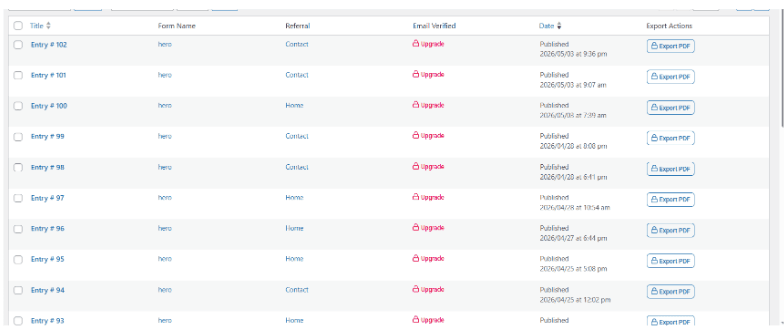
Google Business Profile changes tend to show first, often within weeks. Website rankings for competitive lesson searches follow. As a reference point, a brand-new driving school site Rankixa built from nothing generated 100+ form submissions and 150+ phone calls in its first 4 months.
Which Online Directories Are Most Valuable for Driving Schools to Be Listed In?
The most valuable directories for a UK driving school are the ones learners actually use and the ones search engines trust as confirmation of your business details.
These 10 listings are worth completing first.
- Google Business Profile: Powers Google Maps and the local pack. It is the highest-value listing by a wide margin.
- GOV.UK Find Driving Schools, Lessons and Instructors: The official DVSA service. Approved instructors can choose to be listed, and it carries the trust of a government source.
- Apple Business Connect: Controls how you appear in Apple Maps and Siri, which many learners use on iPhone.
- Bing Places: Feeds Bing and Microsoft’s AI search features. Quick to set up by importing from Google.
- Facebook: Parents ask for instructor recommendations in local groups. A complete page with reviews gives them something to link to.
- Yell: One of the most established UK business directories and a strong, widely referenced citation.
- Trustpilot: A recognised review platform whose star ratings often appear in search results for your school’s name.
- Yelp: Supplies business data to Apple Maps and other services, so it is worth claiming even if few learners browse it.
- Thomson Local and FreeIndex: Long-standing UK directories that add further consistent citations for local search.
- Trade body membership listings: Membership of an instructor association is a trust signal worth displaying, and any member listing that comes with it is a relevant citation.
Complete each listing fully and keep name, address, and phone number identical across all of them. A small number of accurate listings is worth more than dozens of thin ones.
Can Driving Instructors Successfully Manage SEO on Their Own?
Yes. A motivated instructor can manage the fundamentals of SEO alone, particularly in a less competitive area, and getting started costs nothing but time.
Claiming and maintaining a Google Business Profile, asking every pupil for a review, keeping listings consistent, and writing honest pages about your lessons and areas need time more than technical skill. Those tasks alone put many instructors ahead of their local competitors.
The limits appear with technical SEO, link building, and tracking, which take specialist tools and experience. Time is the other constraint: every hour spent on SEO is an hour not teaching. Many instructors handle reviews and posts themselves and hand the technical and strategic work to a specialist.
What Should Driving Schools Check Before Hiring an SEO Agency?
Before hiring an SEO agency, a driving school should check for evidence of results, clarity about the work, and fair terms.
There are 7 things to check.
- Real results with evidence: Ask for case studies with screenshots from Search Console, Google Ads, or Google Business Profile, not rounded claims.
- Local SEO experience: Driving lessons are a local service. The agency should be able to explain map pack ranking factors without notes.
- Knowledge of your industry: An agency that knows the difference between a theory test and a practical test writes better content and needs less of your time.
- A clear list of monthly work: You should know what is being done each month and why. Vague “ongoing optimisation” is a warning sign.
- Reporting tied to enquiries: Reports should show calls, forms, and bookings, with rankings as supporting detail.
- Contract terms and ownership: Check the notice period, and confirm that you own the website, the Google Business Profile, and the analytics accounts.
- No ranking guarantees: No agency controls Google. A promise of first position is a reason to walk away.
An agency that answers all seven openly is far more likely to deliver than one that avoids the questions.
Marketing Beyond SEO
What Are Other Effective Marketing Methods for Driving Schools Besides SEO?
Besides SEO, driving schools can use paid, social, and offline marketing methods. Each works best alongside SEO, not in place of it.
There are 7 methods worth considering.
- Google Ads: Puts you at the top of search results from day one. Useful for a new school, a new area, or a quiet month.
- Local Services Ads: Pay-per-lead adverts shown above standard search ads, where they are available for your category and area.
- Social media advertising: Facebook and Instagram adverts targeted at 17 to 24 year olds and their parents in your postcodes.
- Referral schemes: A discount or free lesson for pupils who recommend a friend. Still the highest-converting source for most instructors.
- School and college partnerships: Student discounts and safety talks that reach learners shortly before they start.
- Vehicle branding: A clearly liveried tuition car is seen for hours every day in exactly the area you teach in.
- Email and WhatsApp follow-up: Prompt replies and reminders to enquiries that did not book straight away recover pupils who would otherwise be lost.
The strongest results come from combining two or three of these with SEO, so that a learner sees your school in more than one place.
Is SEO More Cost-Effective Than Paid Advertising for Driving Schools?
Yes, over the long term. SEO usually costs less per pupil than paid advertising once rankings are established, because clicks from organic results are not charged individually.
Paid advertising is more cost-effective in the short term, because it produces enquiries immediately while SEO is still building. One Rankixa campaign for a driving school produced 68 conversions from £525 of Google Ads spend, at £7.72 each. That is a strong return, but it stops when the budget stops.
The most cost-effective plan uses both: adverts to fill the diary now, and SEO to reduce reliance on them over the following months.
How Can Influencer Marketing Help Improve SEO for Driving Instructors?
Influencer marketing helps SEO by raising local awareness, which leads to brand searches, mentions, and sometimes links.
For a driving instructor, the useful influencers are local and small: a well-followed sixth former documenting their lessons, a local parenting page, or a community group admin. A learner sharing their progress with you reaches exactly the age group about to start lessons.
The effect on rankings is indirect and modest. Treat it as awareness that supports SEO, keep any paid or gifted arrangement clearly disclosed, and measure it by enquiries that mention the creator.
Can Small or Independent Driving Instructors Compete with Large Driving Schools Through SEO?
Yes. Independent instructors can compete with large schools in local search, and often beat them within their own area.
Google ranks local results on relevance, distance, and prominence. A national brand has prominence, but an independent instructor based in the town has distance and can win on relevance with detailed local pages and recent reviews. Learners also tend to prefer a named instructor with visible reviews over an anonymous booking system.
The approach is to stay narrow: cover a few areas thoroughly instead of many thinly, collect reviews steadily, and publish local knowledge a national site cannot match.
How Can Driving Schools Measure the ROI of Their SEO Campaigns?
Driving schools measure SEO return on investment by comparing the revenue from pupils gained through organic search with the cost of the SEO work.
Track enquiries from organic search and Google Business Profile using key events in Google Analytics 4, profile call data, and call tracking. Record how many of those enquiries become pupils. Multiply the number of new pupils by the average value of a pupil across their course, then subtract the SEO cost and divide by that cost.
For example, if SEO brings in 5 extra pupils in a month and each is worth £1,000 across their lessons, that is £5,000 of revenue against the monthly fee. Review the figure quarterly, because pupils enquire in one month and pay across several.
Who Offers the Best SEO Services for Driving Schools Near Me?
The best SEO agency for a driving school is the one that can show measured results for other driving schools. Rankixa is a digital marketing agency in Morden, London, that provides SEO and marketing services for driving schools and driving instructors, and publishes the dashboards behind its results.
Driving schools are where Rankixa has the most published work, covering local SEO, Google Business Profile, and Google Ads:
- Driving School SEO from Scratch: 100+ Forms and 150+ Calls in 4 Months
- Google Business Profile: 0 to 133 Calls in 6 Months with £0 Spend
- Google Ads for a Driving School: 68 Conversions at £7.72 Each
- Low-Budget Google Ads: 18 Conversions from £113 Spend
Which Types of SEO Services Does Rankixa Provide for Driving Schools?
Rankixa provides 10 SEO services for driving schools and instructors, delivered separately or as one managed plan.
- Local SEO for Driving Schools: Google Business Profile optimisation, citations, and map pack rankings across the areas you teach in.
- On-Page SEO for Driving Schools: Lesson and location pages, titles, internal links, and content written around learner searches.
- Technical SEO for Driving Schools: Crawl and indexing fixes, Core Web Vitals, schema markup, sitemaps, and redirects.
- Content Strategy and Marketing for Driving Schools: A topical map covering lessons, test preparation, and safety, published on a monthly schedule.
- Link Building for Driving Schools: Links earned from local schools, community sites, and road safety organisations.
- Off-Page SEO for Driving Schools: Citations, brand mentions, and local partnerships that build authority beyond your own website.
- Reputation Management for Driving Schools: Review request systems, review responses, and monitoring across Google, Facebook, and Trustpilot.
- Conversion Rate Optimization for Driving Schools: Booking forms, call and WhatsApp buttons, and page layouts tested to turn more visitors into pupils.
- Holistic SEO for Driving Schools: One strategy that joins local, technical, content, and links, so each part supports the others.
- LLM Optimization for Driving Schools: Structured data and clear, factual content so that ChatGPT, Gemini, and Google’s AI Overviews describe and recommend your school accurately.
Most driving schools start with local and on-page SEO, then add content and link building as rankings grow.
Can All Types of Driving Schools and Instructors Benefit from Rankixa’s SEO Services?
Yes. Any driving school or instructor whose pupils search online before booking can benefit, and that covers almost all of them.
Independent ADIs gain most from Google Business Profile work and a focused website. Multi-instructor schools benefit from location pages and enquiry tracking across areas. Specialists in intensive courses, automatic tuition, or instructor training benefit from content that targets their particular searches.
The benefit is smallest for an instructor whose diary is already full from referrals and who has no plans to grow. In that case Rankixa will say so.
How Much Does Rankixa Charge for Driving School SEO Services?
Rankixa’s SEO service is £299 per month. Google Business Profile management is £100 per month, Google Ads management is £150 per month plus your ad budget, and websites start from £200 as a one-time cost.
The SEO price covers keyword research, on-page optimisation, monthly content, link building, and a monthly ranking report. At typical UK lesson prices, a single pupil who completes a full course is worth more than several months of the fee, so the service is designed to pay for itself with a small number of extra pupils.
Prices are published in full on the pricing page, and a free audit comes before any commitment.

Rankixa is a digital marketing agency in Morden, London. This guide is written by the team behind Rankixa’s driving school campaigns, using data from live client accounts in Search Console, Google Business Profile, and Google Ads.
Ready to fill your diary?
Get a free SEO audit for your driving school. We reply within 24 hours with a clear list of fixes.


How Can Driving Schools Use Social Media to Support Their SEO Strategy?
Social media supports SEO indirectly. Links from social posts are not a direct ranking factor, but social activity produces the things that are.
Pass photos and short driving tips on Instagram, TikTok, and Facebook build recognition, so more people search for your school by name, and brand searches are a strong local signal. Useful content gets shared and occasionally linked to by local sites. Social profiles also rank for your name, which gives you more of the first page.
Use each post to send people somewhere: a booking page, a guide on your website, or your review link. Keep your name, address, and phone number identical to your other listings.