Contents
- What Does SEO Mean for Roofers?
- Benefits of SEO for Roofing Businesses
- How to Get Started: 17 Steps
- 1. Audit and Keyword Research
- 2. Google Business Profile and Map Pack
- 3. Service Pages, Area Pages, and Conversion
- 4. Technical SEO and Structured Data
- 5. Authority, Content, and Tracking
- Roofing SEO Mistakes to Avoid
- 90-Day Roofing SEO Plan
- Timeline, Cost, Agencies & FAQs
- Rankixa Services & Pricing
- 1Your Roofing Company4.9 (86) · Roofing contractorRepairs & re-roofing · Open now
- 2Town Roofing Services4.6 (42) · Roofing contractorFlat roofing · Closes 5 pm
- 3Northside Roofers4.4 (27) · Roofing contractorEmergency repairs · Closes 6 pm
SEO for roofers is the work of making a roofing company easy to find, and easy to trust, when a homeowner or property manager searches Google for help with a roof.
When someone has a roofing problem, they usually have a few immediate questions like:
- Is there a roofer near me who is available?
- Can I trust this company, or is it a rogue trader?
- What will it cost, and what happens if the work goes wrong?
- Does this company cover my area and my type of roof?
A roof is hard to inspect, so most people judge the business instead of the work. They search Google, compare a few results, check the reviews and accreditations, and call the company that looks real, local and verifiable. A roofer who is not in those results does not get the call.
Trade directories and national brands often sit above local roofers for generic roofing searches. Roofing company SEO closes that gap, because a local roofer wins with what a directory cannot offer: a named crew, live register links, real projects and clear pricing logic.
This roofing SEO guide is written for UK roofing contractors, from sole traders to multi-van firms. It sets out 17 steps in the order that produces enquiries fastest, and it uses Search Console results from a real Rankixa roofing campaign as evidence.
What Is SEO for Roofers?
SEO for roofers, also called roofing SEO or roofer SEO, is the process of optimising a roofing company’s website, Google Business Profile and online listings so that people searching for roofing work in a specific area find that company first. A Google Business Profile is the free listing that shows a business in Google Maps and local results.
Search engine optimization for roofing companies covers three connected jobs. Local SEO puts the business in the Google Maps results for the towns it covers. On-page SEO gives each roofing service and each area its own page. Off-page SEO earns the reviews, listings and links that show Google the company is established.
Search engines match a query such as “flat roof repair Leeds” to the roofer whose pages, profile and reviews answer it best. Roofing contractor SEO works the same way for a sole trader and for a multi-van firm.
Google states that local results are based mainly on three factors, listed below:
- Relevance: how closely the profile and pages match the search.
- Distance: how near the business is to the searcher, or to the area they named.
- Prominence: how well known the business is, which reviews, links and listings influence.
Google also states that a business cannot pay for a better local ranking. Every step in this guide improves at least one of the three factors.
Sources: Google: how local ranking works
How Do Homeowners Search for a Roofer?
Homeowners search for a roofer with one of four intents: emergency, repair, replacement or research, and each intent needs a different page.
Emergency and repair searches are won mainly through the Google Business Profile and fast, phone-first service pages. Replacement and research searches are won with detailed pages and visible proof. A complete roofing SEO plan covers all four.
The four intents, what each searcher needs and the page that answers them are listed below.
| Intent | Example searches | What the searcher needs | Page that answers |
|---|---|---|---|
| Emergency | roof leaking; emergency roofer [town] | A phone number and a believable answer on availability | Google Business Profile and an emergency page |
| Repair | slipped tiles repair; flat roof repair [town]; chimney flashing repair | A clear service, a covered area and recent reviews | A service page for that repair |
| Replacement | new roof [town]; re-roofing | Proof of past work, price logic, guarantee wording and the process | The roof replacement page and project pages |
| Research | how much does a new roof cost; how long does a flat roof last | A sourced, honest answer | A guide that links to the service page |
How Does Roofing SEO Differ from General Local SEO?
Roofing SEO differs from general local SEO in three ways: the customer cannot inspect the work, a re-roof is a large and infrequent purchase, and many searches are urgent.
Those three differences change what a roofing website must do. The page must prove the company is real before the customer rings, and the phone number must be one tap away on a mobile.
| Difference | What it means for the roofer | What to build |
|---|---|---|
| The customer cannot inspect the work | Trust decides the call | Register links, insurance and guarantee wording, real job photos |
| A re-roof is a large, infrequent purchase | The customer researches for days or weeks | Price guidance, process pages and project pages |
| Many searches are urgent | The first credible number wins | A complete Google Business Profile and a visible tap-to-call button |
What Are the Benefits of SEO for Roofing Businesses?
The key benefits of SEO for roofing businesses are more local visibility, better-quality enquiries and a lower cost per job over time. There are 6 main benefits.
- More local enquiries: Ranking in Google Maps and local results puts a roofer in front of people in the towns they cover, which reduces travel between jobs.
- Higher-intent customers: A searcher typing “roof leak repair near me” has a problem to solve now. Search traffic converts better than interruption advertising.
- Lower cost per job: Organic clicks carry no per-click charge, so the cost of each enquiry falls as rankings mature.
- Earlier customer trust: Reviews, job photos, accreditations and guarantee wording answer “can I trust them?” before the first phone call.
- Higher-value jobs: A roofer chooses what to build pages for, so full re-roofs, flat roofing and commercial contracts get dedicated pages instead of only small repairs.
- Stronger position against larger firms: Distance is a local ranking factor, so a roofer based in a town starts with an advantage over a distant national brand in that town.
Together, these benefits turn a website from an online brochure into a source of booked work.
How to Do SEO for Roofers in 17 Steps
An SEO roofing strategy has five parts: audit and keywords, Google Business Profile, service and area pages, technical setup, and authority and tracking. The 17 steps below follow that order, and steps 1 to 8 deliver the fastest return.
Part 1
Audit and Keyword Research
Steps 1 to 3 show where the company stands and which searches are worth winning, so no time goes on fixes that change nothing.
1. Run a Local SEO Audit
A roofer SEO audit checks everything that affects how a roofing company appears in search: the Google Business Profile, service pages, area pages, listings, reviews, speed and technical health. It shows what holds the business back and which fix pays first.
Common findings include a half-empty profile, one generic Services page and no area content. Each of these costs enquiries, and each is quick to fix once found.
The audit covers these eight areas:
- Google Business Profile: Name, phone, website, hours, service areas, categories and photos are complete and correct.
- Service pages: Each roofing service has its own page, not a bullet in a list.
- Area pages: Each main town has a page that is genuinely about that place.
- Keywords: Pages use the words homeowners type, not only trade terms.
- Business listings: Name, address and phone number match on every directory and trade listing.
- Reviews: How many there are, how recent they are, and whether the business replies.
- Mobile experience and speed: Pages load quickly and the phone number is one tap away.
- Technical issues: Broken links, missing titles, duplicate pages and pages Google cannot index.
2. Research the Roofing SEO Keywords Homeowners Search
Roofing SEO keywords are the words people type into Google. Roofing searches pair a service or problem with a place, such as “flat roof repair Bristol” or “roofers near me”, and each search carries an intent that decides which page should answer it.
Roofer SEO keyword research uses three sources: Google’s autocomplete and “People also ask” boxes, Search Console (the searches the site already appears for), and a keyword tool for monthly volumes. Use the customer’s words (“leaking roof”, “new roof”) next to the trade terms (“re-roofing”, “fascias and soffits”). Then assign each keyword to one page, so two pages on the same site never compete for one search. A page targets one primary keyword plus its close variants, such as “roofers Leeds” and “roofing contractors Leeds”, because Google treats them as the same search. The table below sets out roofing SEO keywords by intent, with the page that should rank for each.
| Example search | Intent | Page that should rank |
|---|---|---|
| emergency roofer [town] | Emergency | Google Business Profile and the emergency page |
| roof leak repair near me | Emergency | Google Business Profile and the repair page |
| roofers [town] | Find | Homepage or area page, and Google Business Profile |
| flat roof repair [town] | Repair | Flat roofing page |
| slipped roof tiles repair | Repair | Pitched roof repair page |
| new roof [town] | Replacement | Roof replacement page |
| EPDM or GRP flat roof | Replacement | Flat roofing page, materials section |
| how much does a new roof cost | Research | Cost guide |
| is my roofer NFRC registered | Research | Guide on how to check a roofer |
| roof inspection [town] | Repair | Roof inspection page |
| commercial roofing [town] | Replacement | Commercial roofing page |
| best roofer in [town] | Compare | Reviews page and project pages |

3. Choose the Roofing Jobs You Want
SEO for roofing contractors brings whatever the website has pages for. A company that wants full re-roofs, flat roof installations or maintenance contracts builds its strongest pages for those jobs.
Map the topics in three layers. Services: repairs, re-roofing, flat roofing, tile and slate, chimneys and guttering. Problems: leaks, storm damage, moss and slipped tiles. Decisions: cost, materials, lifespan and guarantees. Each topic gets one page, and each page links to its related topics.
Name who pays as well. Homeowners, landlords, letting agents and housing associations search differently, and commercial roofing is a different buyer journey that needs its own page.
Part 2
Google Business Profile and Map Pack
Steps 4 to 7 decide whether the company appears in the map pack, the block of map results Google shows above standard results for local searches. Most emergency and repair enquiries start there.
4. Claim and Complete Your Google Business Profile
Claim the Google Business Profile, verify it, and claim Bing Places and Apple Business Connect as well. Set “Roofing contractor” as the primary category and add secondary categories only where they are true.
Most roofers travel to customers, which makes them a service-area business. Google allows a service-area business up to 20 service areas, defined by city or postcode and never by radius, within roughly two hours’ driving time of the base. A service-area business has one profile for the whole area it serves, and a business that does not serve customers at its address removes the address from the profile.
Fill in every field:
- Business name: The real trading name, with no extra keywords.
- Phone number and website: The same number and address used everywhere else. The website link points to the homepage.
- Hours: Real hours. “Open 24 hours” appears only when a staffed rota answers every call.
- Service areas: The towns actually covered, within the limits above.
- Description: The roof types, services, accreditations and areas covered, written plainly.
- Services: Each service listed separately: roof repairs, re-roofing, flat roofing, slate and tile, chimney work and guttering.
- Quote link: A direct link to the quote request page.
Sources: Google: service-area businesses
5. Add Photos of Real Jobs
Roofing is a trust purchase, and photos of real jobs show a real business doing real work. Upload before, during and after photos of finished jobs, plus the crew and branded vans, with captions that name the job type and the area.
Use photos taken on the company’s own jobs. Stock images and AI-generated images are not evidence of work and must never be presented as job photos.
6. Build a Review Request System
Reviews do two jobs. They feed prominence, one of the three local ranking factors, and they decide whether a homeowner rings. Recent reviews that name the job and the area are the most useful.
Make asking part of finishing the job. Send a text or WhatsApp message with a direct review link on the day the work ends, reply to every review, and answer negative reviews factually.
Four rules keep a review system inside Google’s guidelines:
- Ask every customer: Do not screen customers before asking, and do not reward positive-only reviews.
- Never write or buy reviews: Fake or paid reviews lead to removed reviews and a suspended profile.
- Make the request one step: A direct link sent by text or WhatsApp removes the search step for the customer.
- Ask for detail, not wording: Ask customers to say what job was done and where, and never script the review.
7. List the Company Where Roofing Customers Check
A citation is a mention of a business’s name, address and phone number on another website. Search engines use citations to confirm that a business is real and consistent, and homeowners use trade and review listings to verify a roofer.
Complete a small number of accurate listings instead of dozens of thin ones, keep the name, address and phone number identical on every one, and list the company only on schemes it actually belongs to.
Start with these:
- Google Business Profile, Bing Places and Apple Business Connect: The three map platforms. Google is the most important.
- Roofing trade body: The National Federation of Roofing Contractors (NFRC) is a UK trade body for roofing contractors. NFRC states that membership is voluntary. A member listing links to a register entry.
- TrustMark: The UK Government-endorsed quality scheme for home improvements. NFRC is one of its scheme providers.
- Review and vetting platforms: Checkatrade, Which? Trusted Traders, Trustatrader and Trustpilot. Join the ones whose entry requirements the company meets.
- General directories: Yell, Thomson Local and FreeIndex add consistent citations.
- Facebook: Local community groups regularly ask for roofer recommendations. A complete page with reviews gives people something to link to.
Sources: NFRC: choosing a roofing contractor
Part 3
Service Pages, Area Pages, and Conversion
Steps 8 to 12 build the pages that rank for services and towns, and turn visitors into phone calls and quote requests.
8. Create a Page for Each Roofing Service
A single Services page cannot rank for ten different searches, because Google needs one page that answers one search. SEO for roofing company service pages therefore follows one rule: one page answers one search. A dedicated page for each service is the largest on-page gain on most roofing websites.
Each page opens with the direct answer to the search, then covers what the service includes, the roof types and materials involved, the process and duration, how it is priced, the guarantee, and a real job with photos. Trade terms are explained in plain English on first use: EPDM is a synthetic rubber flat roof membrane, GRP is glass-reinforced plastic (fibreglass), and lead flashing is the lead strip that seals the joint between a roof and a wall or chimney.
The homepage targets the main service-and-place pair, for example “roofers Leeds”, and links to every service page. Each service page targets its own service, so the homepage and the service pages never compete.
A typical roofing site needs these pages:
- Roof repairs: Leaks, slipped or broken tiles, flashing and ridge repairs.
- Emergency roof repair: A fast, phone-first page for storm damage and active leaks, claiming only availability the company delivers.
- Roof replacement: Materials, process, timeline, guarantees and the compliance position, in depth.
- Flat roofing: The systems the company fits, such as EPDM, GRP and felt, with a comparison table.
- Tile and slate roofs: Repairs, replacement and restoration.
- Chimney work and lead flashing: A common leak source, searched for by name.
- Fascias, soffits and guttering: The roofline work often sold with roofing.
- Commercial roofing: A separate page, because the buyer and the journey differ.

9. Build Genuine Area Pages
Search engine optimization for roofing companies is local by nature. An area page ranks for “roofers in [town]” searches and shows Google where the company works, and it earns that only when it is useful to someone in that town.
Rankixa’s working rule: create an area page only when the company has at least three documented jobs and one local review in that area. Otherwise, list the area on the main page. Each area page then names the typical local roof types, shows those jobs with photos, quotes the local review and lists the neighbouring areas covered.
Copying one page and swapping the town name creates thin content. Google’s spam policies target large numbers of pages created mainly to rank, and those pages do not rank well.
Sources: Google: spam policies
10. Publish Honest Price Guidance
“How much does a new roof cost?” is a common homeowner question, and an honest answer builds trust that “call for a quote” never earns.
Publish a price range only from the company’s own recent jobs. State the scope, what is included (scaffolding, VAT, waste removal), the date, and that the price varies with access, roof size and condition. Third-party price tables disagree widely and must not be copied.
Explain the factors that move the price:
- Roof size and pitch: More area and a steeper pitch mean more materials and labour.
- Materials: Concrete tile, clay tile, natural slate, felt, EPDM and GRP carry different costs.
- Access and scaffolding: Tall or restricted properties need more scaffolding.
- Condition of the structure: Rotten timber or damaged battens found once the covering is off add work.
- Extent of repairs: A patch repair, a section repair and a full re-roof are different jobs.
11. Show Accreditations and Guarantees
Roofing contractor SEO depends on credibility as much as on rankings. Homeowners cannot judge roofing work, so they judge the business, and a badge is only a claim until the homeowner can verify it, so every accreditation links to its register entry and shows the membership number.
Accreditations show competence and standards. They do not show financial strength, so the Companies House entry is worth linking as well.
These are the main UK roofing credentials and what each proves:
- NFRC membership: Membership is voluntary, so an unregistered roofer is not breaking the law. A member appears in the NFRC directory, and the page links to that entry.
- NFRC Competent Person Scheme (CompetentRoofer): NFRC states that registered members self-certify qualifying roofing work in England and Wales against Building Regulations. Say which work is certified and which certificate the customer receives.
- TrustMark: The UK Government-endorsed quality scheme for home improvements. Link the register entry.
- RoofCERT: A skills certification for individual roofers. Show names and cards.
- National Heritage Roofing Contractors Register: Relevant only to roofers who work on listed or historic buildings and qualify.
- Insurance: State the type of cover (public liability, and employer’s liability where the company has employees) and the insurer, and keep the certificate on file. Quote the company’s actual policies, not a figure from a directory.
- Guarantee: State who gives it, what it covers, how long it runs and whether it is insurance-backed. NFRC recommends an Insurance Backed Guarantee because it still pays out if the contractor stops trading. Never call a guarantee insurance-backed unless it is.
| If the copy says | Proof required before publishing |
|---|---|
| “NFRC member” or “CompetentRoofer” | A live register entry with the number, linked |
| “TrustMark registered” | The TrustMark register entry, linked |
| “Fully insured” | The certificate on file, with the cover types stated |
| “Guaranteed for X years” | The written guarantee wording, and who backs it |
| “Over X years’ experience” | A verifiable start date or Companies House history |
| “5-star rated” | A link to the platform, with a matching number |
| “Emergency 24/7” | A staffed rota and a measured response time |
| “Response within X hours” | A documented average from the last 90 days |
| Prices or price ranges | Real job data, scope, VAT status and date |
| “No hidden extras” | A list of the genuine possible extras: scaffolding, rotten timber, skips |
Sources: NFRC: choosing a roofing contractor, TrustMark, GOV.UK, Planning Portal
12. Make Calling and Quoting Effortless
A leaking roof is stressful, and many roofing searches happen on a phone. The phone number, the WhatsApp link and the quote form appear on every page and in the footer.
Build these into every page:
- Tap-to-call button: A visible number that dials on tap, fixed to the top or bottom of the screen on mobile.
- Short quote form: Name, phone, postcode and the problem. Every extra field lowers completions.
- Photo upload or WhatsApp: Customers send a photo of the damage, so the first answer is better informed.
- A plain-English process: Survey, written quote, contract, payment terms, any variation agreed in writing, completion and guarantee. NFRC advises customers to get the chosen quote in writing and to agree payment terms before work starts.
- Honest response times: Publish a response time only when the company has measured it over the last 90 days, and promise nothing it does not deliver.
Part 4
Technical SEO and Structured Data
Steps 13 and 14 make sure Google can find, understand and trust the site, and that it works well on a phone.
13. Fix the Technical Basics
Technical SEO for roofing company websites is the health of the site behind the pages. If Google cannot crawl or index a page, the page does not rank, and slow pages lose customers on mobile data.
Core Web Vitals are Google’s page-experience measures. Largest Contentful Paint (LCP) measures loading, Interaction to Next Paint (INP) measures responsiveness, and Cumulative Layout Shift (CLS) measures visual stability. Google’s “good” thresholds are 2.5 seconds for LCP, 200 milliseconds for INP and 0.1 for CLS.
Check these basics:
- Mobile-friendly design: Most roofing searches happen on a phone, so test every key page on one.
- Page speed: Compress photos, which are the usual cause of slow roofing sites, and avoid heavy sliders.
- HTTPS: The whole site loads securely.
- Indexing: Key pages are indexable, return a 200 status, carry a self-referencing canonical tag and sit in an XML sitemap submitted to Search Console.
- Content visible without JavaScript: Text, headings and links are in the page, not hidden behind scripts.
- Unique titles and headings: Each page has its own title tag, meta description and one main heading.
- Clean structure: No broken links and no duplicate pages, with redirects when URLs change.
Sources: web.dev: Core Web Vitals
14. Add RoofingContractor Schema
Structured data, or schema markup, is code that labels a page’s facts for search engines. Schema.org defines a RoofingContractor type, a kind of LocalBusiness, which fits a roofing company’s name, address, phone number, opening hours and service areas.
Use the most specific subtype, include the required name and address, and add the telephone number, URL, geographic coordinates, opening hours and areaServed for the genuine service areas only. The markup must match the visible text on the page and the Google Business Profile.
Google scopes review and rating markup to sites that collect reviews of other businesses, so a roofer does not rely on it for their own reviews. FAQ rich results stopped appearing in Google Search on 7 May 2026, so FAQPage markup produces no visible result, although it remains valid and harmless. Google states that its AI features need no special markup.
Sources: Schema.org: RoofingContractor, Google: local business structured data, Search Engine Journal: FAQ rich results
Authority, Content, and Tracking
Steps 15 to 17 build the reputation that lifts rankings over time and prove which work brings in jobs.
15. Earn Local and Trade Links
A link from another website is a vote of confidence, and in an SEO roofing campaign a few relevant links outweigh hundreds of low-quality ones. Aim for links from sources that match the company’s real attributes.
Realistic sources for a roofing company:
- Trade body and manufacturer listings: Accreditation schemes and product manufacturers list approved installers with a link. Claim every listing the company is entitled to.
- Suppliers and partners: Builders’ merchants, scaffolders and other trades link to recommended contractors.
- Community and charity work: A real job for a local school, club or charity earns local mentions.
- Local press: A storm-damage tip, a heritage roof project or an apprenticeship story earns coverage.
- Landlord and housing partners: Letting agent and housing association contractor pages link to approved roofers.
Sources: Google: spam policies
16. Publish Seasonal Guides
Helpful guides capture the research searches that come before a booking: signs a roof needs replacing, what to do after a storm, how to spot a leak, how long a roof lasts and what a fair quote includes. Each guide links to the service page it supports.
Demand is seasonal, and roofing SEO marketing follows it. Leak and storm-damage searches typically rise in autumn and winter, and planned replacements and flat roof projects often peak in drier months. Publish and refresh a guide before its season, not during it, and review the seasonal pages every quarter.
Every guide about a leak, storm damage or loose tiles tells the reader not to climb onto the roof, and a qualified roofer reviews it before publication. Pre-arrival advice stays factual: protect belongings, collect water safely, photograph the damage for an insurance claim and call a professional. It never promises a fix.
17. Track Calls and Jobs
A ranking report does not pay invoices. The measure of roofing SEO is the number of calls and quote requests it produces, and how many become jobs.
Set up tracking for these:
- Google Search Console: Shows the searches and pages that earn impressions and clicks, and any indexing problems.
- Google Analytics 4 key events: Count phone-button taps, quote form submissions and WhatsApp clicks.
- Call tracking: Shows which calls come from search. Keep one number per page, and the same number across listings.
- Google Business Profile performance: Reports calls, direction requests and website clicks from the profile.
- A job log: Records where every enquiry came from and the value of the job, so the real return on SEO is visible.
- A monthly query log: Records the date, the target search and the result shown, including any AI answer, so changes are visible over time.

SEO for roofing businesses works as a sequence: these 17 steps take a company from an unclaimed profile and a thin website to a site that brings in repair and re-roofing enquiries every week.
What Are the Most Common Roofing SEO Mistakes?
These 9 mistakes cost roofing companies the most enquiries.
- Using One Generic Services Page: A single page cannot rank for repairs, replacements, flat roofing and emergencies at once. Give each service its own page.
- Copying Area Pages: Fifty pages that differ only by town name are thin content. A few well-evidenced area pages are worth more.
- Stuffing Keywords into the Business Name: Adding “Emergency Roof Repairs Leeds” to the profile name breaks Google’s guidelines and risks suspension.
- Hiding the Phone Number: A worried homeowner on a mobile who cannot find the number contacts another roofer.
- Promising 24/7 Cover Without a Rota: Claiming round-the-clock cover and missing calls costs jobs and earns bad reviews.
- Ignoring Reviews: Few, old or unanswered reviews make the company look like the riskier choice.
- Using Stock Photos as Job Evidence: Customers cannot judge the work, so they judge the proof. Show real jobs.
- Showing Badges Without Register Links: A logo with no register entry and no number is only a claim. Link every accreditation.
- Tracking Rankings Instead of Calls: A page-one position that brings no calls is a vanity metric. Track enquiries and jobs.
What Does a 90-Day Roofing SEO Plan Include?
A 90-day SEO roofing plan gives roofers a realistic order of work. The first month fixes what costs the most, the second builds the pages that rank, and the third adds authority and measurement.
| Period | Focus | What gets done |
|---|---|---|
| Days 1–30 | Foundations | Audit, keyword and intent map, complete Google Business Profile, review request system, listing clean-up, tap-to-call and quote form, technical fixes |
| Days 31–60 | Pages and proof | Pages for the top services, the first evidenced area pages, price guidance, accreditations and guarantee wording with register links, schema markup |
| Days 61–90 | Authority and tracking | Local link outreach, first seasonal guides, call and form tracking, first report of calls and jobs, plan for the next quarter |
Roofing SEO marketing compounds over time, so the second quarter builds on the first. Keep the monthly review and the quarterly seasonal refresh going after day 90.
What Else Should Roofers Know Before Investing in SEO?
The questions below cover the timeline, cost, alternatives and hiring decisions that come after the 17 steps.
How Long Does SEO Take for Roofers?
SEO for roofers produces its first movement in 4 to 8 weeks and consistent enquiries in 3 to 6 months, and competitive towns take 6 to 12 months to reach top positions. These ranges are Rankixa’s planning figures from its own campaigns, not Google figures, and competition, site quality and consistency move them.
Google Business Profile changes show first, often within weeks. Website rankings for competitive searches follow.
After setup, the weekly work for the roofer is small: a review request after each finished job, photos of each job and a reply to each new review. The technical, page and link work sits with the specialist.
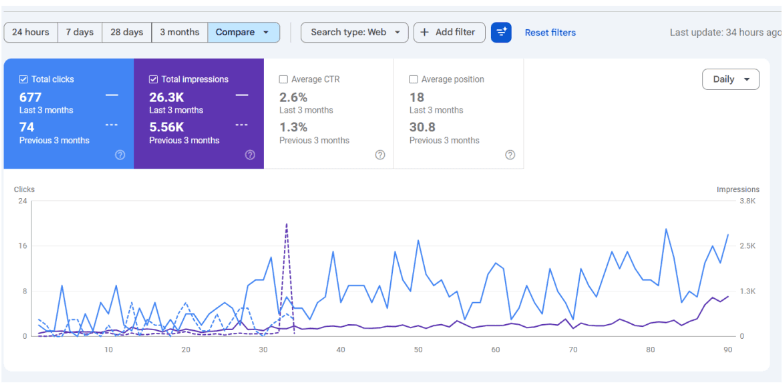
A UK SEO roofing campaign run by Rankixa recorded 8.5K clicks and 639K impressions at an average position of 15.3 between 1 January and 31 March 2026. Position 15.3 is the bottom of page two: the foundation was in place and the pages were still climbing.
How Much Does SEO for Roofers Cost in the UK?
Rankixa’s roofing company SEO service costs £299 per month. UK agency retainers vary with scope, local competition and the amount of content and link work included.
Four factors set the price of roofing SEO:
- Scope: SEO alone costs less than SEO combined with Google Business Profile management, Google Ads or a new website.
- Local competition: More roofers, directories and national brands in a town mean more work to reach the top positions.
- Content volume: Service pages, area pages and monthly guides each take writing and review time.
- Reporting: A report of calls and enquiries takes more setup than a ranking report.
A fair monthly fee covers keyword research, on-page work, monthly content, link building, Google Business Profile support and a report of calls and enquiries. To judge value, multiply the average value of a job by the extra jobs SEO brings each month and compare the result with the fee. Rankixa publishes its full prices on the pricing page.
What Are the Pros and Cons of Roofing SEO?
The main pro of roofing SEO is a lasting source of enquiries that costs less per job over time, and the main con is that results take months and no ranking is guaranteed.
| Pros | Cons |
|---|---|
| Builds an asset the roofer owns | Takes 3 to 6 months to produce consistent enquiries |
| Cost per job falls as rankings mature | No agency or tool guarantees a position on Google |
| Reaches people who are searching for a roofer now | Needs steady input: reviews, job photos and fresh pages |
| Builds trust before the first phone call | Competitive towns take 6 to 12 months |
| Compounds: each page and review adds to the next | Needs tracking to prove which work produces jobs |
Roofing SEO pros and cons both depend on planning. A clear order of work, steady input and tracking tied to calls and jobs shrink the cons, and the 17 steps above provide all three.
Is SEO Better Than Checkatrade or MyBuilder for Roofers?
SEO builds an asset a roofer owns, whereas lead platforms rent a roofer access to customers, and the two do different jobs.
| Factor | SEO | Lead platforms |
|---|---|---|
| Cost model | A monthly fee with no charge per click or per lead | Membership or a fee per lead, which varies by platform |
| Who controls the enquiry | It arrives directly at the roofer | The platform controls it, and some platforms send the same job to several roofers (MyJobQuote tells homeowners they receive up to 3 quotes) |
| Speed | Months | Days |
| Cost over time | Falls as rankings mature | Continues for as long as the roofer uses the platform |
| Where trust comes from | The roofer’s own website, reviews and proof | The platform’s vetting and review badges |
Platforms deliver work quickly, and SEO reduces dependence on them over time. A sensible plan uses a platform for immediate work while SEO builds, then moves spend to the channel with the lowest cost per job.
Is SEO More Cost-Effective Than Google Ads for Roofers?
SEO usually costs less per job than Google Ads once rankings are established, and Google Ads produces enquiries immediately.
| Factor | SEO | Google Ads |
|---|---|---|
| Time to first enquiries | Weeks to months | Immediate |
| Cost over time | Falls as rankings mature | Charged per click for as long as the campaign runs |
| Best use | A steady base of enquiries across services and towns | Emergency and storm-damage searches, and quiet months |
| When it stops | Rankings persist when the work pauses | Enquiries stop when the budget stops |
The most cost-effective plan uses both: ads to fill the diary now, and SEO to reduce reliance on them over the following months. Rankixa runs both under its Google Ads and local SEO services.
Which Directories Should Roofers Use?
The most valuable directories for a UK roofer are the ones homeowners use to check a roofer and the ones search engines trust to confirm business details.
These 9 listings come first:
- Google Business Profile: Powers Google Maps and the map pack. It is the highest-value listing by a wide margin.
- Apple Business Connect: Controls how the business appears in Apple Maps and Siri on iPhones.
- Bing Places: Feeds Bing and Microsoft’s AI search features. Importing from Google makes setup quick.
- NFRC member listing: Applies to NFRC members only. It is a trust signal and a relevant citation.
- TrustMark: Applies to businesses that meet the scheme’s requirements.
- Checkatrade and Which? Trusted Traders: Widely recognised vetting and review platforms for businesses accepted onto them.
- Trustpilot: Its star ratings often appear in search results for the company name.
- Yell, Thomson Local and FreeIndex: Long-standing UK directories that add consistent citations.
- Facebook: Community groups regularly ask for roofer recommendations.
Each listing is completed fully, with the name, address and phone number identical everywhere. The company joins only the schemes whose requirements it meets.
What Should Roofers Check Before Hiring an SEO Agency?
Before hiring an SEO agency or roofing SEO pros, a roofing company checks for evidence of results, clarity about the work and fair terms.
There are 7 checks:
- Real results with evidence: Case studies with Search Console or Google Business Profile screenshots, not rounded claims.
- Local SEO experience: The agency explains map pack ranking factors without notes.
- Knowledge of roofing: An agency that knows the difference between EPDM and GRP, or a repair and a re-roof, writes better pages and needs less of the roofer’s time.
- A clear list of monthly work: The roofer knows what is done each month and why. Vague “ongoing optimisation” and bulk-generated pages are warning signs.
- Reporting tied to enquiries: Reports show calls, forms and jobs, with rankings as supporting detail.
- Contract terms and ownership: The notice period is clear, and the roofer owns the website, the Google Business Profile and the analytics accounts.
- No ranking guarantees: No agency controls Google, so a promise of first position is a reason to decline the agency.
An agency that answers all seven openly is far more likely to deliver than one that avoids the questions.
Which Tools Do Roofers Need for SEO?
SEO for roofers runs on five free Google tools plus two paid ones: a keyword tool and a call tracking service.
The tools are listed below:
- Google Search Console (free): Shows the searches, clicks and impressions the site earns, and any indexing problems.
- Google Business Profile (free): Manages the map listing and reports calls, direction requests and website clicks.
- Google Analytics 4 (free): Records key events for phone-button taps, quote forms and WhatsApp clicks.
- PageSpeed Insights (free): Reports Core Web Vitals and speed problems page by page.
- Schema Markup Validator or Rich Results Test (free): Checks that structured data is valid.
- A keyword and rank tool (paid): Semrush and Ahrefs supply monthly search volumes, competitor pages and rank tracking.
- A call tracking service (paid): Shows which calls come from search.
Which Black-Hat SEO Practices Do Roofers Avoid?
Roofers avoid six black-hat practices, because each one breaks Google’s guidelines or spam policies and risks lost rankings or a suspended profile.
The six practices are listed below:
- Fake or paid reviews: Google removes them, and the profile risks suspension.
- Keyword-stuffed business names: A name such as “ABC Roofing – Cheap Emergency Roof Repairs Leeds” breaks the profile guidelines.
- Fake addresses and duplicate profiles: A service-area business has one profile for the whole area it serves.
- Bought links and link schemes: Google’s spam policies treat them as violations.
- Copied area pages: Pages that differ only by town name are thin content created mainly to rank.
- Hidden text and repeated keywords: Text written for search engines instead of readers breaks the spam policies.
Each shortcut has a lasting replacement in the 17 steps: real reviews, an honest profile, evidenced area pages and earned links.
Sources: Google: spam policies, Google: service-area businesses
What Other Marketing Methods Work for Roofers?
Roofing SEO marketing works best alongside paid, social and offline methods, and roofing companies use all four.
There are 6 methods:
- Google Ads: Puts the company at the top of search results from day one, which suits emergency searches and quiet months.
- Lead and vetting platforms: Checkatrade, MyBuilder and similar sites deliver enquiries quickly at a cost per lead or per month.
- Referrals and repeat work: Referrals remain the highest-converting source for many roofers, so every happy customer is asked, and landlords and agents are kept in touch.
- Social media and community groups: Before-and-after photos on Facebook and Instagram, and helpful replies in local groups, build recognition.
- Vehicle branding and site boards: A marked van and a board outside a job are seen by neighbours who later look for a roofer.
- Email and WhatsApp follow-up: A prompt reply to every quote, plus a follow-up, recovers jobs that stall.
The strongest results combine two or three of these with SEO, so a customer sees the company in more than one place.
How Do Roofers Measure the ROI of SEO?
Roofers measure SEO return on investment by comparing the revenue from jobs won through organic search with the cost of the SEO work.
Enquiries from organic search and the Google Business Profile are recorded with Google Analytics 4 key events, profile call data and call tracking. The job log records how many enquiries become jobs and what each job is worth. The formula is (revenue minus SEO cost) divided by SEO cost.
For example, 2 extra jobs at an average value of £3,000 against a £299 monthly fee return £6,000 of revenue. These figures are illustrative: the roofer replaces them with their own job values. The figure is reviewed quarterly, because large jobs take weeks to move from enquiry to payment.
How Do AI Search Tools Recommend Roofers?
Google states that AI Overviews and AI Mode run on its core ranking systems and need no special optimisation beyond standard SEO, so the 17 steps apply unchanged.
Google states that an appearance in an AI feature is never guaranteed, and that no extra files or markup are required. The actions that matter are the ones already covered: clear service pages, consistent business details, verifiable accreditations and recent reviews.
Sources: Google: AI features and your website
Does SEO Work for Roofing Companies?
Yes. SEO works for roofing companies because homeowners search Google at the moment they need a roofer, and a company that appears in those results receives the call.
A UK roofing site Rankixa worked on recorded 8.5K clicks and 639K impressions between 1 January and 31 March 2026. Results vary with competition, site quality and consistency, and no agency guarantees a position.
Can Roofers Do SEO Themselves?
Yes. A roofer manages the fundamentals of SEO alone: claiming and maintaining the Google Business Profile, asking every customer for a review, keeping listings consistent and photographing each job.
Technical SEO, link building and tracking take specialist tools and experience, and every hour spent on them is an hour not spent quoting or on a roof. Many roofers handle reviews and photos themselves and hand the technical and strategic work to a specialist.
Can a Small Roofing Company Outrank Larger Firms and Directories?
Yes, within its own area. Google ranks local results on relevance, distance and prominence. A national brand holds prominence, whereas a roofer based in the town holds distance and wins relevance with detailed local pages, real job photos and recent reviews.
Directories keep many generic positions, so the local roofer targets specific service-and-place searches, where it holds the advantage.
Do Roofers Need a Website If They Have a Google Business Profile?
Yes. A profile ranks mainly close to its registered location, holds limited detail, and sits on a platform the roofer does not control.
A website with service and area pages extends reach, supports the profile’s rankings and captures searches that show no map. A suspended profile removes visibility until Google reinstates it.
Do Roofers Need a Blog?
Yes. Helpful guides capture the research searches that come before a booking, such as cost and lifespan questions, and they feed visitors to the service pages.
Is SEO Necessary for Roofing Contractors?
Yes. SEO for roofing contractors is necessary for any company that wants steady enquiries without depending only on referrals or lead platforms.
Referrals depend on past work, and platforms charge for access. SEO builds a profile and pages the roofer owns, and they bring in enquiries every month.
Rankixa runs Google Ads management, Google Business Profile management and local SEO for local trades, and publishes its prices in full.
Who Offers SEO Services for Roofers Near Me?
A roofing company chooses the agency that shows measured results for other trades. Rankixa is a digital marketing agency in Morden, London, that provides roofing contractor SEO and marketing services for roofing companies and other local trades, and it publishes the Search Console screenshots behind its results.
Rankixa’s published results include a UK SEO roofing campaign and results for other local trades:
- UK Roofing SEO Case Study: 8.5K Clicks and 639K Impressions in 3 Months
- UK Plumbing SEO: 1.57K Clicks and 189K Impressions in 3 Months
- SEO from Scratch: 100+ Forms and 150+ Calls in 4 Months
- Google Business Profile: 0 to 133 Calls in 6 Months with £0 Spend
Which SEO Services Does Rankixa Provide for Roofing Contractors?
Rankixa provides 10 services within search engine optimization for roofing companies, delivered separately or as one managed plan.
- Local SEO for Roofers: Google Business Profile optimisation, citations and map pack rankings across the towns the company covers.
- On-Page SEO for Roofers: Service and area pages, titles, internal links and content written around homeowner searches.
- Technical SEO for Roofers: Crawl and indexing fixes, Core Web Vitals, schema markup, sitemaps and redirects.
- Content Strategy for Roofers: A topical map covering repairs, replacements, costs and storm damage, published on a monthly schedule.
- Link Building for Roofers: Links earned from trade bodies, suppliers, local businesses and community sites.
- Off-Page SEO for Roofers: Citations, brand mentions and local partnerships that build authority beyond the website.
- Reputation Management for Roofers: Review request systems, review responses and monitoring across Google, Facebook and Trustpilot.
- Conversion Rate Optimization for Roofers: Tap-to-call buttons, quote forms and page layouts tested to turn more visitors into enquiries.
- Holistic SEO for Roofers: One strategy that joins local, technical, content and links, so each part supports the others.
- LLM Optimization for Roofers: Clear, factual content and structured data so that ChatGPT, Gemini and Google’s AI features describe the company accurately.
Most roofing companies start with local and on-page SEO, then add content and link building as rankings grow.
Can All Types of Roofing Companies Benefit from Rankixa’s SEO Services?
Yes. Any roofing company whose customers search online before hiring benefits, and that covers almost all of them.
Sole-trader roofers gain most from Google Business Profile work and a focused website. Multi-van firms benefit from service and area page structure and enquiry tracking. Specialists in flat roofing, slate or commercial work benefit from content that targets their particular searches.
The benefit is smallest for a roofer whose diary is already full from referrals and who has no plans to grow. In that case Rankixa says so.
How Much Does Rankixa Charge for Roofing SEO?
Rankixa’s roofing company SEO service is £299 per month. Google Business Profile management is £100 per month, Google Ads management is £150 per month plus the ad budget, and websites start from £200 as a one-time cost.
The SEO price covers keyword research, on-page optimisation, monthly content, link building and a monthly ranking report. A free audit comes before any commitment, and the full prices are on the pricing page.
Rankixa is a digital marketing agency in Morden, London. This guide is written by the team behind Rankixa’s local SEO campaigns for trades, using data from live client accounts in Search Console, Google Business Profile, and Google Ads.
Drafted with AI assistance from Rankixa’s campaign data. Key facts were checked against the primary sources linked in each section.
Ready for more roofing jobs?
Get a free SEO audit for your roofing company. We reply within 24 hours with a clear list of fixes.